
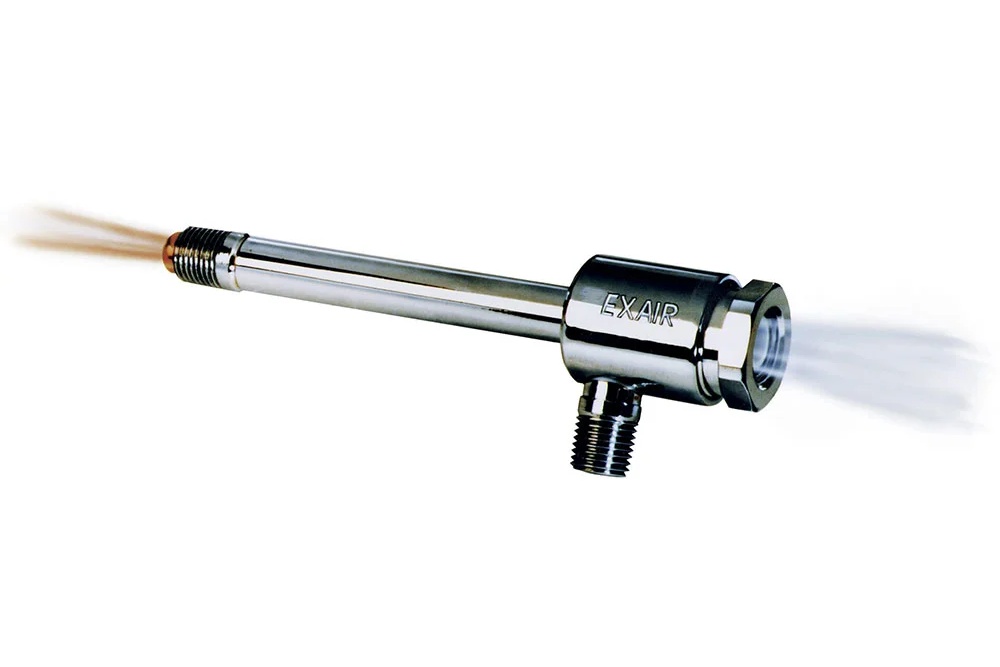
In many production environments, managing heat quickly and precisely can make a real difference to product quality, equipment lifespan and overall efficiency. When machinery overheats or materials need rapid cooling, traditional refrigeration systems are not always practical. They can be bulky, require maintenance, and involve moving parts that eventually wear out. This is where a vortex tube becomes especially useful.
A vortex tube is a compact, air operated device that separates compressed air into two streams (one hot and one cold) without any refrigerants or mechanical components. It sounds complex, but the concept is surprisingly straightforward. By simply using compressed air, the device generates a stream of cold air that can be directed exactly where it is needed. For production facilities looking for reliable and low-maintenance spot cooling, this technology has become an increasingly popular solution, including across industrial operations in Thailand.
The Science Behind the Vortex Effect
The operating principle of a vortex tube dates back to experiments conducted in the early 20th century by Georges Ranque. While working on compressed air systems, he discovered that when air is forced to spin at high speed inside a chamber, it naturally separates into hot and cold streams. This phenomenon, sometimes referred to as the Ranque-Hilsch effect, remains one of the most interesting examples of energy separation in fluid dynamics.
Here is what happens inside the tube. Compressed air enters a chamber and is directed into a rapid circular motion. This spinning motion creates a vortex, similar to a miniature tornado within the tube. As the air rotates at high velocity, temperature separation occurs. The outer layer of the vortex becomes hotter, while the inner core becomes colder. By allowing some of the air to exit from the hot end and directing the colder inner stream out the opposite side, the device provides two distinct temperature flows from a single compressed air source.
The remarkable part is that this entire process happens without electrical components, refrigerant gases, or moving mechanical parts. That simplicity contributes to durability and makes the vortex tube suitable for demanding industrial settings.
Controlling Temperature Through Air Pressure and Cold Fraction
One of the key advantages of a vortex tube is the ability to control both airflow and temperature. Two primary factors influence performance: supply pressure and cold fraction.
- Supply pressure plays a significant role because higher pressure means more energy entering the system. When compressed air pressure increases, the temperature difference between the hot and cold streams becomes greater. In practical terms, this means colder cold air and hotter hot air. For production managers, adjusting pressure offers a straightforward way to fine-tune cooling intensity without changing equipment.
- The second factor is known as the cold fraction. This refers to the percentage of incoming compressed air that exits through the cold end. By adjusting a control valve on the hot side, operators can increase or decrease how much air escapes as hot flow. When more air is allowed to exit from the hot end, the cold stream becomes colder but its flow rate decreases. When less hot air is released, the cold stream flow increases but at a slightly higher temperature.
This balance between temperature and volume allows vortex tubes to adapt to a wide variety of industrial requirements, from gentle component cooling to deep temperature reduction for specific processes.


Choosing the Right Configuration for Your Application
Vortex tubes are typically available in different sizes and configurations, each designed to deliver varying airflow capacities. Smaller models consume lower volumes of compressed air and are suitable for compact machinery or enclosed panels. Medium and larger units provide higher flow rates, making them appropriate for cooling larger surfaces, molds or high-heat equipment.
Another important distinction involves the internal generator type as some configurations prioritise maximum refrigeration capacity, delivering higher volumes of moderately cold air for rapid cooling tasks. Others focus on achieving the lowest possible temperature, producing extremely cold air at reduced flow rates. The selection depends on whether the goal is fast heat removal or reaching sub-zero temperatures for specialized applications.
In many production environments, vortex tubes are used to cool control cabinets, prevent overheating in machining operations, solidify materials quickly, or stabilise temperatures during sensitive manufacturing steps. Their compact design allows them to be installed close to the heat source, reducing energy waste and improving process consistency.
A Reliable Cooling Option for Modern Production
As manufacturing processes become more precise, the need for controlled temperature management continues to grow. Vortex tubes offer a compact and dependable solution for spot cooling without the complexity of traditional refrigeration systems. By adjusting air pressure and cold fraction, operators can tailor both temperature and airflow to match the task at hand. For facilities seeking practical industrial cooling solutions, we supply a range of products designed to support production efficiency and equipment protection. With the right configuration and proper setup, vortex tube technology can deliver consistent performance in demanding industrial environments while keeping systems simple and reliable.


